


Because Somebody Had to Write It
Every Brazilian Jiu-Jitsu academy has its own culture, but some rules are universal. Whether you train in the gi or prefer no-gi, there is a baseline of etiquette that keeps everyone safe, healthy, and willing to roll with you again. Some of these rules are common sense. Others, apparently, need to be said out loud.
So let’s say them.
The Quick Reference Chart
Before we break it all down, here is the full etiquette chart for both gi and no-gi training. Print it. Laminate it. Tape it to the locker room wall.
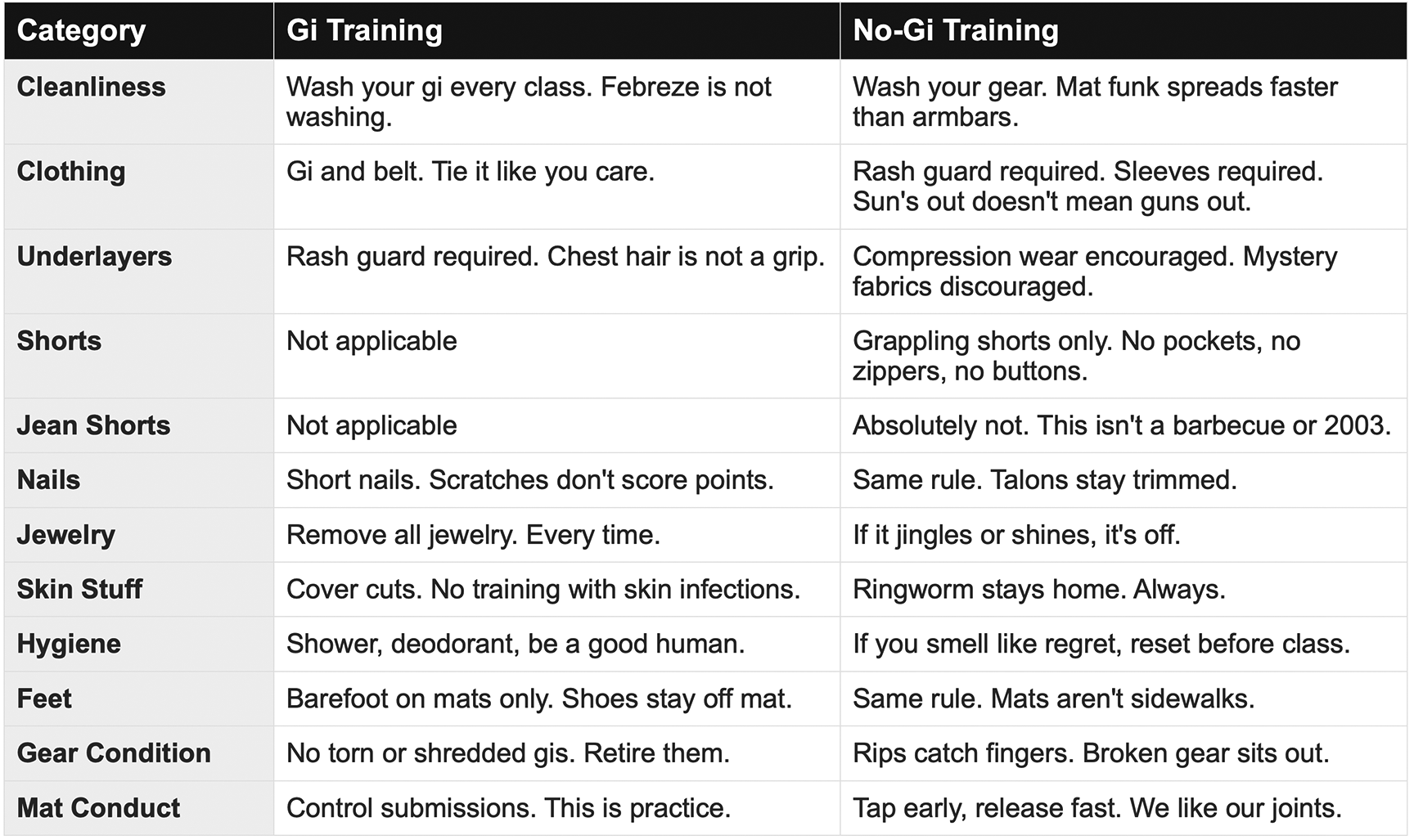
Start With the Basics: Be Clean
This should go without saying, but experience has taught every coach on the planet that it cannot go without saying. Wash your gear after every single class. Not every other class. Not when it “starts to smell.” Every. Single. Class.
If you train in the gi, that gi gets washed before it touches the mat again. Febreze is not washing. If you train no-gi, the same rule applies to your rash guard, shorts, and anything else that absorbed your sweat for an hour. Mat funk spreads faster than armbars, and nobody wants to be the reason the whole room smells like a forgotten gym bag, or somebody needs to go on antibiotics.
And while we are on the topic: shower before class, wear deodorant, and just generally be a good human. If you smell like regret, reset before class. According to research retrieved from PubMed, close quarters combined with poor hygiene practices make athletes particularly vulnerable to contracting skin diseases, and certified athletic trainers consistently identify hygiene lapses as a primary driver of infection outbreaks in combat sport settings (Zinder et al. 411).
What to Wear (and What to Leave at Home)
Gi training is straightforward. You wear a gi and a belt, and you tie it like you care. If you’re not sure how, check out the Bayshore BJJ Youtube page– we have multiple videos on how to do it. Underneath, a rash guard is required. Chest hair is not a grip, but it will get pulled like one, and nobody is going to apologize for it.
No-gi is where things get more interesting, and where the dress code violations tend to pile up. The standard is a rash guard with sleeves and grappling shorts. Sun’s out doesn’t mean guns out. No sleeveless shirts, because armpits are not a submission and nobody wants their face buried in one. It means grappling shorts only, with no pockets, no zippers, and no buttons, because those catch fingers, scratch skin, and create problems that did not need to exist.
Compression wear is encouraged underneath your shorts. Mystery fabrics from the back of your closet are discouraged. If you do not know what it is made of, it probably should not be pressed against someone else’s face.
And then there is the jean shorts question. The answer is: absolutely not. This is not a barbecue. This is not 2003. Denim has no place on a jiu-jitsu mat. If you showed up in jean shorts, you are not rolling today. You are going home to rethink some choices.
Nails, Jewelry, and Skin Health
Short nails. This is non-negotiable in both gi and no-gi. Scratches don’t score points, and long nails are one of the fastest ways to earn a reputation as the training partner everyone avoids. Talons stay trimmed.
Remove all jewelry. Every time. If it jingles or shines, it is off before you step on the mat. Rings, necklaces, earrings, watches, all of it. Jewelry catches on fabric, scratches skin, and creates injury risks that are entirely preventable.
Skin health deserves its own serious mention. Cover cuts. No training with skin infections. Ringworm stays home. Always. No exceptions. Based on articles retrieved from PubMed, cutaneous infections are common in combat sport athletes and frequently result in lost training time. From 1988 to 2004, approximately 20% of practice-related sports medicine conditions in NCAA wrestlers that led to missed practice time involved skin infections (Wilson et al. 423). One person training with an active infection can affect an entire gym. The responsible move is always to stay home, get treatment, and come back when you are cleared. If you notice you have a rash of any type, or a pimple with redness around it, either stay home, or at the least ask an instructor before you get on the mat. They will likely tell you to skip class for safety reasons, but better to be safe than sorry.
Footwear and Mat Hygiene
Barefoot on mats only. Shoes stay off the mats. When you leave the mat to use the restroom or walk through the lobby, put sandals or slides on. When you come back, take them off before you step onto the training surface. Mats aren’t sidewalks.
Every time someone walks off the mat barefoot and comes back, they are potentially tracking bacteria and debris onto a surface where people are going to put their faces. According to PubMed research, a multi-year NCAA surveillance study found that most skin infections in collegiate wrestlers were identified during practice, with 74.1% of reported infections resulting in at least 24 hours of lost training time (Herzog et al. 457). Clean mats matter. Clean feet matter more.
Gear Condition
Inspect your gear regularly. No torn or shredded gis. Retire them. A gi with holes is not “broken in.” It is broken. In no-gi, rips catch fingers. Broken gear sits out. Ripped rash guards and shorts with loose seams catch fingers and toes, leading to unnecessary injuries. If your gear has seen better days, or has a funk to it, it is time to replace it.
Mat Conduct
Remain positive at all times. This is a learning process. Don’t celebrate “wins” or show frustration with your “losses” on the mat.
Keep conversations appropriate and respectful, and never talk while your instructors are teaching. This goes for when you’re off the mat too. If you are walking in for class and the instructor is addressing the class before yours, keep your trap shut.
Control your limbs, and your body weight. Do not be the person who is crashing into your training partners, and dealing out feet and elbows to the face. Safety doesn’t start with applying submissions, it starts the moment you step on the mat.
Do not Control submissions. This is practice, not a competition finals match. Apply them with enough technique to get the tap, not enough force to cause injury. In no-gi especially, where the pace tends to be faster and transitions happen quickly, the emphasis on controlled submissions matters even more.
Tap early, release fast. We like our joints. There is no prize for toughing out an armbar in practice. Release immediately when your partner taps. The goal is for everyone to leave practice healthier and more skilled than when they arrived, and that requires mutual respect and self-control from everyone on the mat.
Off Mat Etiquette
Being part of a team means you are always representing the academy to some degree. Make sure your day to day actions reflect academy culture as well.
DO NOT “drop into teammates DMs.” The mat is NOT your Tinder, and flirting in any capacity with teammates or family members of students is STRONGLY discouraged, and in some cases can result in expulsion from the academy. Don’t sh*t where we all eat.
Do not wear academy gear when you’re planning to be intoxicated. What you do on your own time is your business, but don’t be representing ours when you’re no of right mind.
The Bottom Line
Mat etiquette is not complicated. Be clean, dress appropriately, take care of your body and your gear, and treat your training partners the way you want to be treated. These are not suggestions. They are the standards that keep a gym running safely and keep the culture strong. Follow them, and you will always be a welcome training partner. Ignore them, and someone is going to have a conversation with you. Possibly while holding a bottle of hand sanitizer.
Works Cited
Herzog, Mackenzie M., et al. “Epidemiology of Skin Infections in Men’s Wrestling: Analysis of 2009-2010 Through 2013-2014 National Collegiate Athletic Association Surveillance Data.” Journal of Athletic Training, vol. 52, no. 5, 2017, pp. 457-463. DOI: 10.4085/1062-6050-52.2.16.
Wilson, Eugene K., et al. “Cutaneous Infections in Wrestlers.” Sports Health, vol. 5, no. 5, 2013, pp. 423-37. DOI: 10.1177/1941738113481179.
Zinder, Steven M., et al. “National Athletic Trainers’ Association Position Statement: Skin Diseases.” Journal of Athletic Training, vol. 45, no. 4, 2010, pp. 411-28. DOI: 10.4085/1062-6050-45.4.411.